
News
Listen to the Sound of "Flowers" Blooming
Listen to the Sound of "Flowers" Blooming
——Exploring the Path of Intellectual Property Empowering the Transformation and Upgrade of the "Beautiful Economy"
This spring and summer, the flower industry has frequently gone viral. From the "blossoms all along the way" on Beijing's ring roads to various cities showcasing their own "Monet Gardens," the flower industry has become deeply integrated into urban life and people's daily routines. At the 2026 Beijing International Flower Exhibition, our reporter went to the frontline to explore the intellectual property support behind the upgrade of the "beautiful economy" in the flower industry.
On May 30, the 33-day 2026 Beijing International Flower Exhibition, held in the Lize Financial Business District of Fengtai District, Beijing, came to a successful close. It welcomed a total of 770,000 visitors and drove a 24% increase in surrounding consumption.
The integration of cities with the flower industry can provide momentum for stimulating consumption and driving economic growth. This is a vivid practice of Fengtai District's efforts to create a "Garden City Special Zone" since the beginning of this year. Huaxiang (Flower Town) area in Fengtai District is located on the alluvial fan plain of the Yongding River, with a crisscrossing network of waterways and fertile land. It has over 800 years of history in flower cultivation, forming a distinctive geographical indication industrial cluster centered on flowers, and is also an important flower distribution hub and modern flower industry agglomeration area in northern China.
However, now that it is located in Beijing's central urban area, where large tracts of land for flower production are hard to come by, how can Fengtai District sustain the reputation of "Flower Town" and revitalize its flower industry?
In recent years, Fengtai District has seized the opportunity presented by the construction of garden cities, introducing a number of policies and measures to promote the transformation, upgrade, and high-quality development of the flower industry. These policies and measures all cover intellectual property-related content such as seed industry innovation, technological innovation, brand building, and tapping the development potential of geographical indications.
In practice, Fengtai District has actively promoted the upgrade of the "beautiful industry," with Beijing Huaxiang Huamu Group (hereinafter referred to as Huaxiang Huamu) as the leading enterprise. It has pushed for the transformation of the traditional flower planting and wholesale business model into a whole ecological industry chain integrating R&D, production, sales, sightseeing, and services. By comprehensively utilizing intellectual property rights such as patent technologies, trademark brands, and geographical indications, it has strongly supported the construction of a modern flower industry system in Fengtai District.
Integrating Intellectual Property into Experience-Based Services
"Fengtai District possesses five major flower geographical indications: Fengtai Peony, Huaxiang Peony, Huaxiang Rose, Huaxiang Jasmine, and Caoqiao Chrysanthemum." said Zhang Tiejun, Deputy Director of the Fengtai District Market Supervision and Administration Bureau (Intellectual Property Office). In recent years, Fengtai District has continuously amplified the agglomeration effect of flower geographical indication brands, enhancing their visibility, reputation, and market influence.
"Constrained by land resources, we are exploring the deep integration of geographical indication flowers into landscaping, parks, and other flower-related services," introduced Sun Guangming, Deputy General Manager of Huaxiang Huamu. The company showcases geographical indication flowers to the public in scenarios such as road greening and parks, making them part of the consumption upgrade and experience-based services in the flower industry.
With the added historical and cultural depth of geographical indications, the flower industry has more stories to tell, maximizing the "emotional value" of experience-based services.
Huaxiang Park, located in Baipenyao Village, was one of the venues for this flower exhibition. During the exhibition, Huaxiang Peony, Fengtai Peony, and Huaxiang Rose entered their peak blooming periods successively. Meng Lingying, the park manager, introduced that the park has been developing the under-forest economy in recent years, reintroducing flowers historically grown in Baipenyao Village, such as peonies, peonies, and roses, in large quantities. Currently, the park grows over 300 mu of Huaxiang Peony and Fengtai Peony, making it the largest planting base for peonies in the Beijing area.
"Stories are what attract people the most," Meng Lingying said. Huaxiang Park delves deep into the stories behind its geographical indications, adding another layer of cultural heritage to Huaxiang Peony.
During the Kangxi reign of the Qing Dynasty, the 19-year-old Princess Gu Lun married a Mongol noble. As part of her dowry, she brought a peony cultivated in Baipenyao Village from the imperial garden. Over the next 300-plus years, this "dowry peony" was meticulously cared for by the princess's descendants and continues to flourish to this day. In 2021, the people of Baipenyao hoped to reintroduce the "dowry peony" to their hometown, and the princess's descendants gave two branched plants as gifts, which were successfully transplanted back to Huaxiang Park.
"The princess's descendants regard the 'dowry peony' as an invaluable treasure and are reluctant to propagate it easily. Even when family members were married with branched plants, they were difficult to keep alive. But when we went to obtain the plants, the descendants readily agreed, and the transplants immediately adapted to their native soil, growing wonderfully in the park." Meng Lingying's account adds a legendary touch to the story.
In 2022, the trademark "Baipenyao Dowry Peony" was approved for registration. Since Huaxiang Park opened in 2023, it has promoted the "Baipenyao Dowry Peony" IP through situational plays like "Return to Hometown," as well as traditional painting, handicraft experiences, Hanfu shows, and flower deity parades, making the geographical indication culture tangible and attracting many visitors.
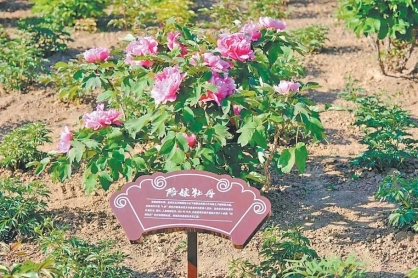
Baipenyao Dowry Peony
Trademark brand building is also given high priority as an important means of cultivating new consumption in the flower industry.
During the flower exhibition, people often saw young ladies in Hanfu promoting bonsai products at the "Zhaohuage" booth. "Zhaohuage" is a self-developed Chinese-style floral art brand created by Huaxiang Huamu. Its trademark was registered in 2025, representing the group's efforts, as the leading flower enterprise in Fengtai District, to generate new momentum for the flower industry. The brand breaks away from the traditional single paradigm of flower sales, creating a comprehensive flower culture experience space encompassing bonsai, aromatic home goods, and flower-based foods and drinks. It has already opened four stores in Beijing.
On the eve of the Spring Festival in 2024 and 2025, the Secretary of the Fengtai District Party Committee appeared on a talk show, bringing the "Zhaohuage" self-designed combined bonsai products "Wufang Xianrui" and "Hongyun Dangtou" as representative New Year's flowers from Fengtai District to the show on two occasions, boosting the brand's reputation. "Zhaohuage" also actively explores a "flower +" multi-integration model, creating numerous derivative products and cultural creative items, activating new forms of cultural consumption, and polishing the Huaxiang cultural IP.
"As a next step, Fengtai District will integrate its historical and cultural flower resources, shape the 'Jingpin · Fenghua' regional public brand, unify brand standards, and enhance brand value. We will increase brand promotion efforts, tell the story of Fengtai's 'Flower Town,' and further enhance the visibility and reputation of Fengtai flowers in both domestic and international markets," introduced Zhao Yuting, Deputy Director of the Fengtai District Gardening and Greening Bureau.
Opportunities and Challenges in Seed Industry Innovation
"Several of our carefully selected premium alpine azalea varieties have been designated as special reception flowers for foreign affairs at the Great Hall of the People, realizing the return of a century-old renowned flower to its homeland as a tribute to the nation," Liu Hongmei, Chairwoman of Shandong Hongmei Horticulture Technology Co., Ltd. (hereinafter referred to as Hongmei Horticulture), told our reporter at the Master Garden site of the flower exhibition. "The garden we are in is called the 'Ritual Garden,' designed by renowned British horticultural designer Mark Gregory. It is structured around alpine azaleas, using the azalea products provided by our company. During the initial garden construction, Mark told us he wanted to present alpine azaleas as the highest form of hospitality to Chinese gardens."
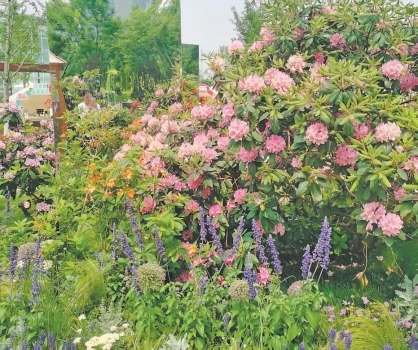
A garden structured around alpine azaleas
Why did Mark choose alpine azaleas? Liu Hongmei explained that over 100 years ago, alpine azalea germplasm resources originally from Southwest China flowed to Europe, evolving into tens of thousands of commercialized new azalea varieties, becoming an important category in European and American gardens and landscapes. Through this Ritual Garden project, these overseas-bred azalea varieties have returned to their native homeland, undergoing domestication and cultivation at the origin of the germplasm in Guizhou and large-scale breeding bases in Shandong. This was both Mark's original intention in his design and Liu Hongmei's persistent pursuit over more than 20 years in the alpine azalea industry, driving the return of this famous flower to its roots.
"Each imported azalea plant comes with a clearly marked price for its new plant variety right," Liu Hongmei admitted. Bringing them back to China involved paying substantial intellectual property fees. This situation applies not only to azaleas but also to most flower varieties, including roses and peonies, making her realize the critical importance of owning independent intellectual property for the development of the flower industry.
In 2022, the National Forestry and Grassland Administration and the Ministry of Agriculture and Rural Affairs jointly issued the "Guiding Opinions on Promoting High-Quality Development of the Flower Industry," proposing that by 2025, a basic system for flower seed industry innovation should be established, and the market share of flower varieties with independent intellectual property should steadily increase. By 2035, a sound and complete flower seed industry innovation system should be in place, the localization rate of major commercial flower varieties should be significantly improved, a comprehensive flower industry system should be essentially built, and annual sales revenue should exceed 700 billion yuan.
The "2025 China Forestry and Grassland New Plant Varieties and Intellectual Property Annual Report," released in April 2026, shows that during the "14th Five-Year Plan" period, China's forestry and grassland technological innovation vitality significantly increased, and the intellectual property protection system continued to improve. Applications for new plant variety rights reached 10,377, with 4,551 grants. Among these, grants for ornamental varieties were three times that of the "13th Five-Year Plan" period.
Overall, flower seed industry innovation is trending positively, with broad industry prospects, but some developmental issues remain.
"In the domestic flower market, independent breeding and new plant variety rights struggle to realize their due value," Liu Hongmei said. Despite her original intention to use China's alpine azalea germplasm resources to breed new varieties, as a business owner, she is cautious about applying for new plant variety rights: "For the new azalea varieties we breed independently, we participate in various flower exhibitions. Only for those that receive good consumer feedback and show commercial potential do we then apply for new plant variety rights."
Gao Li, head of the Beijing Huaxiang Flower Science and Technology Research Institute, a subsidiary of Huaxiang Huamu, shares the same view. In her opinion, the commercial prospects of a new variety are key to realizing its economic value. She used the example of a series of aster varieties, independently bred by her institute and one of Fengtai's key new varieties at the exhibition, to illustrate the direction of breeding choices and market prospect assessment. This variety began R&D in 2017, was launched in 2025, and sold about 200,000 plants this spring. "Although the current volume is not large, the market prospects are very good," Gao Li said. Asters are perennial herbaceous plants that bloom in autumn. Their blue-purple flowers complement the predominantly red and yellow chrysanthemum products in the autumn market. Combined with their long blooming period, abundant flowers, disease resistance, low maintenance costs, and the current gap in similar domestic and international research and market, the potential for them to become a major commodity is high. The institute has chosen a multi-layered IP strategy, applying for a patent for the aster tissue culture method and using the "Huaxiang" trademark. Currently, the aster series with the "Huaxiang®" mark is featured at the forefront of Huaxiang Huamu's product catalog and promoted nationwide.
In essence, whether the economic value of new plant varieties can be fully unleashed touches upon the issue of transforming achievements from independent intellectual property. In the flower industry, this problem manifests as, on one hand, a disconnect between R&D and market demand, where new varieties lack commercial attributes, and on the other, a lack of specialized promotion and operation by producer services, meaning good varieties are not widely known. Flower seed industry innovation urgently needs to connect the front and back ends of the industrial chain, allowing the market to guide variety development and enabling excellent varieties to be quickly accepted by consumers.
This issue may find a solution path in the future Beijing International Flower Science and Innovation Center. This project is the "core engine" for high-quality development of Fengtai's flower industry, planning a construction area of approximately 60,000 square meters. It aims to create a headquarters economy-style green science and innovation park integrating flower technology, trade, and culture. "The project will focus on four major themes: 'Flower Technology, Flower Culture and Tourism, Flower Healing, and Flower Life.' In the future, it will introduce flower research institutes, breeding enterprises, and innovation platforms, focusing on seed industry innovation and digital flowers to build a national-level production-research hub. It will also deepen the integration of government, industry, academia, research, and application, encourage the on-site transformation of research results, and cultivate a group of innovative flower enterprises with core competitiveness," Zhao Yuting introduced. She hopes that the entire flower industry can establish a complete, virtuous cycle of new variety development, promotion, and trading as soon as possible, continuously activating the endogenous driving force for the industry's development.

scan my wechat